
WEDDING PHOTOS · WITHOUT THE AWKWARD POSING
Hate Having Your Photo Taken? How to Get Natural Wedding Photos Without Feeling Awkward
If you want natural wedding photos but the thought of wedding portraits fills you with dread, you do not need to learn how to pose. You need a photographer who knows what to do with that nervousness once the camera comes out.

After more than fifteen years photographing weddings, I reckon I get maybe one couple a year where both people are genuinely excited about having their photograph taken. Not one person who quite likes it while the other tolerates it. Both of them actively keen.
Everyone else falls somewhere on the spectrum between, “We’re a bit awkward in photographs,” and, “I absolutely hate cameras and this is the part of the wedding I’m dreading.” Loads of my couples also confess that they barely have any photographs of themselves together that they actually like.
And that includes the couples you’re looking at all over my website. They aren’t models. They didn’t arrive at their wedding already knowing what to do with their hands, which angle photographs best or how to casually look incredible while somebody points a professional camera at them. They’re normal people who have told me many of the same things you might be thinking right now.

One of my brides, Jen, put it better than I ever could.
She and Rowan are now exactly the kind of couple somebody else might look at on my website and think, Well yes, but they’re obviously good in photographs. They weren’t.
That is the bit I really want you to understand before we go any further. The people in my portfolio weren’t already good at being photographed. You can read Jen’s full review, alongside plenty of others from couples who felt awkward or uncomfortable in front of the camera, on my reviews page.
So how do we get from “that is never going to be us” to the photographs you’re looking at now? You don’t need to become good at having your photograph taken.
“When researching at the beginning of our wedding planning, I never thought that we would ever be able to end up with anything close to those showcase portfolio shots that Kelsie showed us — but MY OH MY — she truly pulled it out of the bag.”
Knowing how to look good in photographs isn’t your job. Knowing how to photograph you well is mine.
You Probably Don’t Hate Photographs. You Hate Feeling Photographed.
There are lots of reasons someone might describe themselves as camera-shy. Some people are self-conscious about how they look. Some hate being the centre of attention. Some become horribly aware of their hands the second a camera appears. Others have seen enough bad photographs of themselves that they’ve become convinced they simply aren’t photogenic.
For lots of people, though, the thing they actually hate is the sensation of being photographed. They don’t want to spend their wedding mentally checking what their chin is doing, where their hands are or whether their smile looks normal. They don’t want to perform affection for a stranger holding a camera, and they certainly don’t want to be constantly interrupted, rearranged and asked to repeat things that already happened naturally five minutes ago.
They also don’t want an hour of the wedding they spent months planning to disappear into a photoshoot they were dreading in the first place. That is very different from hating photographs.

How to Look Natural in Wedding Photos Without Knowing How to Pose
There is something slightly ridiculous about putting two perfectly normal people in front of a professional camera and expecting them to suddenly know what to do with every part of their body. Most people have barely been professionally photographed before they get engaged. Then their wedding arrives and apparently they are meant to instinctively understand flattering angles, body position, hands, light and how to look completely relaxed while being intensely aware that somebody is taking their photograph.
Of course that can feel awkward. I don’t think the answer is to make you responsible for fixing that awkwardness. You do not need to practise twelve poses in the mirror, memorise a Pinterest board or spend the months before your wedding learning what to do with your left hand.
Behind the camera, I’m thinking about how bodies photograph, what the light is doing, whether an angle is helping, how your clothes are sitting and whether moving myself or moving you slightly would make the photograph stronger. I’m also watching for that moment where somebody starts thinking too much and their whole body suddenly gets a bit more rigid. There is a lot going on in my head. You just don’t need all of it going on in yours too.
Natural Wedding Photography Does Not Mean No Direction
This is where I think the wedding industry occasionally gets itself into a bit of a muddle. Natural wedding photography gets described in all sorts of ways — relaxed, candid, documentary, unposed — but none of those words have to mean your photographer simply stands back and leaves you to figure everything out. We’ve somehow ended up with “natural” on one side and “posed” on the other, as though your only two options are a photographer who never says a word to you or somebody carefully arranging every finger and telling you exactly where to point your chin.
There is an enormous and very useful space in between. For most of your wedding day, I’m watching. I’m learning who matters to whom, anticipating what is about to happen and looking beyond the most obvious photograph. If your dad sees you for the first time and gets emotional, I’m not interrupting it because I have a better composition in mind. If you’re laughing with your bridesmaids, I’m not stopping everyone and asking them to look at me. If your new husband pulls you into him after the ceremony, I’m not asking him to put you back and do it again more neatly. The moment is already doing exactly what it needs to do.
Couple portraits are slightly different. If I take you away from your guests, stand you in a beautiful patch of light and then say absolutely nothing while you both wonder what on earth you’re supposed to be doing, I haven’t created a wonderfully documentary experience. I’ve just abandoned you in a field. Relaxed doesn’t have to mean hands-off. I’ll step in when direction helps, and get back out of the way when it doesn’t.


The Posing Knowledge Is Underneath It. What You Experience Is a Prompt.
I am absolutely thinking about posing when I photograph you. I just don’t necessarily want you thinking about posing. There is an important difference.
I might know that I want your weight to shift, your legs to soften and your bodies to settle more naturally together. I could talk you through each of those things individually, or I could say, “Ooh, just sway together like you’re at your first school dance, but cuddled up exactly as you are.” Suddenly your knees soften, your weight moves, your shoulders relax and you stop wondering how you should be standing because now you’re actually doing something together.
That is much more how I like to direct people. I know what I want the body to do, but I’d rather get you there through a little bit of movement, a reaction or something that makes sense to the two of you than talk you through a checklist of body parts.
The same goes for expression. I could carefully arrange a groom’s arms around his new wife, tell them both to look at one another and then ask them to smile. Or I can put them somewhere that photographs beautifully and enthusiastically remind him that this woman is now his WIFE, so frankly he had better wrap both arms around her accordingly. Now his hands have somewhere to go. She’s probably laughing at me. He’s pulled her closer without thinking about it, and before either of them has had time to wonder what their face is doing, I’ve got the photograph.
There is still intention underneath all of that. I know what I’m trying to create physically within the frame. I’m simply changing the energy of the moment instead of asking you to perform the finished photograph for me.
Change the energy of the moment, and the photographs change with it.
I’M YOUR MIRROR
I’ll Clock the Things You Can’t See. You Get to Stay in the Moment.
One of the things I tell my couples is: I’m your mirror.
I’m a photographer and I still cannot reliably take a good photograph that somebody else is taking of me. I know my own angles really well when I can see myself, but when somebody else is holding the camera I have no idea that I’ve suddenly done something odd with my shoulders, pushed my head forward or moved in a way that just doesn’t work particularly well from where they’re standing. Then I look at the photograph afterwards and immediately go, “Can we take that again?” because now I can see it.
You don’t have that mirror when I’m photographing you, so I become it. I’m checking that your hair is sitting nicely, that your clothes are falling properly and that whatever you’re naturally doing works from the angle I’m photographing it from. If something is slightly off, I can usually change it without turning your portrait session into a running commentary on your body.
Often I won’t correct an individual body part at all. I’ll give you something small to do that naturally sorts several things at once, like that little first-school-dance sway. You move, the tension disappears and suddenly everything looks more fluid without you ever having to think, Right, soften left knee, shift weight, relax shoulder.
I’m paying a huge amount of attention to what your body is doing, but I don’t need you paying a huge amount of attention to what your body is doing. I’d much rather you were laughing with your partner, reacting to whatever ridiculous thing I’ve just said and forgetting to monitor yourself altogether.

Natural Photographs and Flattering Photographs Are Not Opposites
I think there can be a strange pressure within “natural” photography to pretend nobody cares how they look. Of course you care. You’re probably going to look at these photographs for the rest of your life. Wanting them to feel real does not mean you suddenly have to be delighted by every possible camera angle or decide that flattering photography no longer matters. That balance between photographs feeling real and still having intention behind them is also a big part of how I think about editorial wedding photography.
You are allowed to want natural photographs and want to look bloody good in them.
There is also an enormous amount of pressure around weddings to change your body before the day. If getting stronger, exercising or changing something makes you feel fantastic, brilliant. What I don’t want is for somebody to look at beautifully photographed people and assume the difference between those people and them is simply the number on the scales.
How a person photographs is affected by so much more than weight. Posture changes how clothes fall. How somebody is standing changes their silhouette. Light, lens choice, camera distance, angle and timing all make a difference too. Sometimes someone has simply rounded their shoulders because they’re nervous or gone rigid because the camera appeared. Those are things I can respond to without turning the experience into a list of things you need to “fix” about yourself.
I’m going to write a whole separate guide about this because there are genuinely useful things to know about posture and photographs that have absolutely nothing to do with trying to become smaller before your wedding. For now, the important bit is that you don’t need to spend your portraits analysing your own body so intensely that you miss the person standing in front of you.
You are allowed to want natural photographs and want to look bloody good in them.

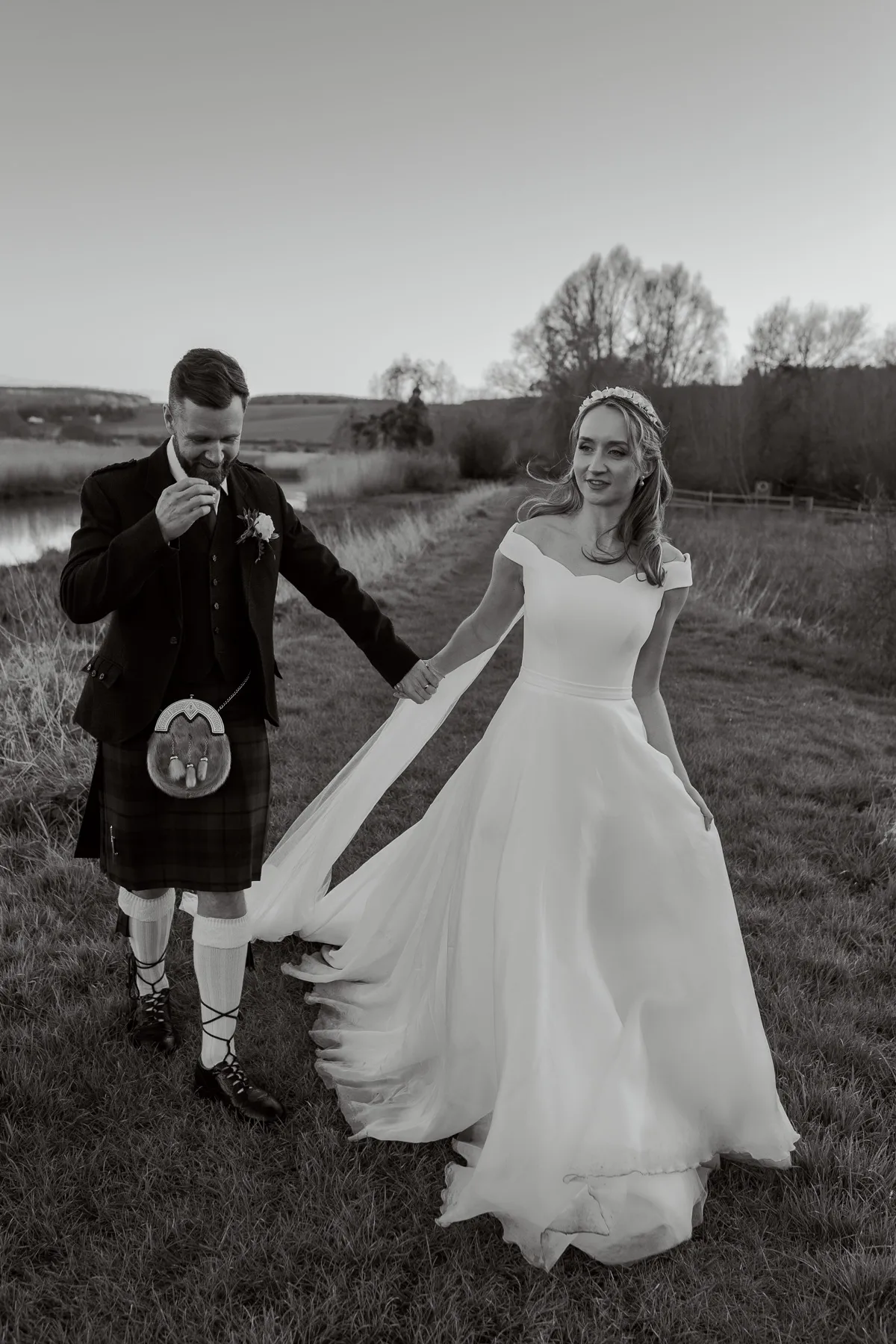
Your Photographs Should Look Like You, Not Like My Last Wedding
Some couples are incredibly affectionate. Some show love primarily by taking the absolute piss out of each other. Some are quiet, some are chaotic, and some naturally spend half their lives wrapped around each other. All of those relationships can photograph beautifully.
My job is not to take the prompts that worked brilliantly with the couple I photographed last Saturday and run you through exactly the same routine. One couple might need something playful because that is what gets them out of their heads. Another naturally falls into each other the second I stop talking. Someone quieter may look far more like themselves simply walking together and chatting than being asked for a big reaction.
And if you aren’t particularly touchy-feely in real life, I don’t want your wedding gallery to suddenly suggest that you spent twelve hours pressed forehead-to-forehead gazing wistfully at one another. This is why getting to know my couples before the wedding matters so much. The better I understand your personalities, relationship and the people around you, the less I have to figure out while there is a camera pointed at you.
Your photographs should feel like you, not like my last wedding.
For most of your wedding day, you have far better things to be doing than thinking about my camera.
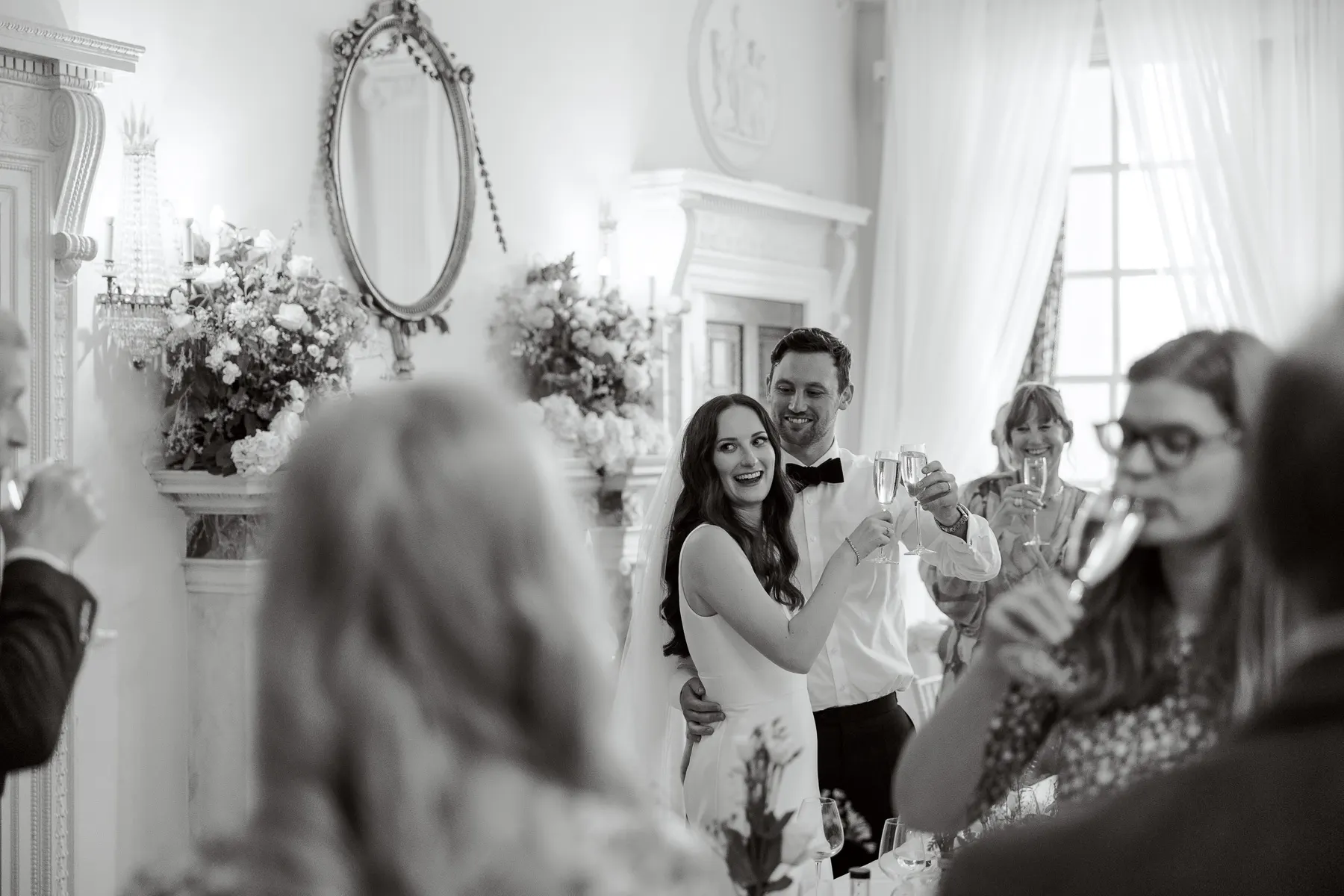
For Most of Your Wedding Day, You Don’t Need to Participate in the Photography
If you’re imagining that hiring a wedding photographer means spending the entire day conscious of being photographed, this is probably the bit I most want you to know. For most of the wedding, you have far better things to be doing.
You’re getting married. You’re seeing people you haven’t seen in ages. Someone has put champagne in your hand. Your best friend has started crying. Your uncle has decided he owns the dance floor.
I’m photographing all of it, but you don’t have to participate in the photography for those photographs to exist. In fact, some of the most important photographs I make are ones the people in them never knew I took.
That experience shows up repeatedly in the messages my couples send afterwards. People who warned me beforehand that they were uncomfortable with cameras tell me that they forgot I was photographing them, or that photographs they hadn’t even realised were being taken became some of their favourites. That is exactly what I want.
Being camera-shy doesn’t particularly worry me because I don’t require you to become comfortable performing for a camera all day. There will be moments when I’m very present and helpful, and much longer stretches where I’m simply paying attention.
You Do Not Need an Hour-Long Couple Photoshoot
I suspect this is another fear hiding underneath, “We hate having our photograph taken.” People imagine disappearing from their own wedding for an enormous portrait session while everybody they love carries on drinking champagne without them.
That isn’t what I want either. Your guests did not travel across the country so you could spend two hours standing in a field with me while your wedding breakfast goes cold.
Sometimes we might have five or ten minutes before dinner. Sometimes we’ll pop outside again for a little pocket of beautiful evening light. Some couples genuinely love portraits and want to give them more time, while others want the handful of beautiful photographs that matter to them and then to get straight back to their people. There isn’t one correct amount. Photography should fit around the wedding you actually want to experience.
Strangely, those little portrait pockets often end up being much nicer than nervous couples expected anyway. Weddings are loud and everyone wants you. There is nearly always someone waiting to congratulate you, ask a question or hand you something. Stepping away for ten minutes can be one of the first chances you’ve had all day to actually look at the person you have just married and go, “Oh my God. We actually did that.”
And if couple portraits genuinely aren’t important to you, rather than simply making you nervous, tell me that too. I’m not interested in convincing every couple that they secretly want exactly the same wedding photographs.
“But I Never Like Photos of Myself”
This is slightly different from feeling awkward while a photograph is being taken. You might be perfectly comfortable around a camera and still dread seeing the result. Maybe you have an angle you hate, one feature you become fixated on or a photograph somebody once took of you that you despised so much it has somehow become evidence for every photograph taken since.
Tell me. Not because I want you thinking about every insecurity you have all day, but because information helps me look after you.
There are technical choices involved in making a flattering photograph. Light matters. Lens choice matters. Distance and angle matter. Timing matters. What your body is doing in that fraction of a second matters. And a photograph really is a tiny fraction of a second from a moving human being. We all make strange expressions while we talk, laugh, eat, cry and generally exist. Photograph anyone often enough and there will be individual frames they would never choose as their new profile picture.
That does not mean you are unphotogenic. It means you are a person who moves. My job isn’t to prove that every millisecond of your wedding belongs in a frame on the wall. It is to recognise the photographs that feel wonderful, flattering and true to you and build your finished gallery from those.
I’ve had people tell me afterwards that they didn’t know they could love photographs of themselves. Those messages mean an enormous amount to me, because being convinced that you’re “bad in photographs” is not remotely the same thing as actually being difficult to photograph.
Should Camera-Shy Couples Have an Engagement Session?
Maybe, but not because you need photography lessons. I don’t think an engagement session should be remedial training for people who are supposedly bad at photographs. You are not coming along to learn twelve wedding poses before the exam.
The real benefit is familiarity. You find out what it feels like to be photographed by this particular person. You discover that when I give you a slightly odd prompt there is a method behind it, while I learn what makes the two of you laugh, what kind of direction works, what feels completely wrong for you and how much input you actually want from me.
Then on the wedding day, I’m not a stranger pointing a large camera at you and hoping we all click. We have already done this. For someone who is particularly anxious about being photographed, that familiarity can make an enormous difference. But if the thought of an engagement session brings you absolutely no joy and neither of you wants one, I’m not going to tell you that your wedding photographs are doomed without it. There are plenty of ways to build trust before a wedding.
What If One of You Hates Having Their Photo Taken More Than the Other?
Often one person loves photographs and has been saving wedding imagery for months, while their partner’s contribution to photography planning is approximately, “Please don’t make this weird.” That is completely workable. You do not both need to arrive with matching levels of enthusiasm.
What matters is that nobody feels as though portraits are something being done to them. If one person is hesitant, I’ll meet them there. We don’t need to start with intense eye contact and romantic grandeur. We can move, talk, have a laugh and take the pressure out of it.
Usually the fastest route to making someone dislike being photographed is to make them feel trapped in it. So I don’t.
IF THIS IS ONE OF YOUR BIGGEST WEDDING WORRIES
How to Choose a Wedding Photographer If You’re Camera-Shy
If you’ve been searching for natural, relaxed or candid wedding photography because you hate posing, look beyond whether you simply like a photographer’s twenty best portfolio images.
Look at complete weddings. Look at what people are doing when they aren’t staring at the camera. Look at their hands, shoulders, expressions and the in-between photographs. Look at the guests. Do different couples actually feel like different people, or does everybody seem to have been worked through exactly the same collection of poses?
Then ask the photographer what actually happens when somebody says, “We hate having our picture taken.” “I’ll make you feel relaxed” is lovely, but how? Do they give direction during portraits? What kind? How much of the day will you actually spend looking at the camera? How long do they normally take couples away from their guests? What happens if one of you freezes up? Can you tell them about something that makes you particularly self-conscious? Can you see a full wedding gallery rather than just the photographs chosen for Instagram?
Most importantly, pay attention to how their answer makes you feel. You should come away thinking, Ohhh. Okay. I can do that. Not as though you have just been given a six-month training programme before you are deemed wedding-photo ready.
You Don’t Need Confidence in Front of a Camera
Confidence in front of a camera is not the prerequisite. You need a wedding you’re enjoying, somebody beside you that you quite clearly fancy enough to marry, and a photographer who understands when to observe, when to direct, when to prompt, when to hype you up and when to disappear.
I care enormously about making photographs where you look incredible. I also care whether you enjoyed the life that was happening while I made them, because very often the latter is exactly what makes the former possible.
So if you have been telling yourselves that you hate having your photo taken, that you’re awkward, that you never know what to do or that portraits are going to be the worst part of your wedding, tell me. You don’t need to apologise for it, and you certainly don’t need to fix it before you arrive.
You don’t need to be good at having your photograph taken. You need a photographer who is good at photographing you.
KEEP PLANNING
A Few Useful Things to Read Next
If this guide has taken some of the pressure off, these are the bits I’d read next.
STYLE + APPROACHEditorial wedding photography without posing the life out of youSEE WHAT I MEAN →
RELATED GUIDEHow to create a wedding timeline that actually lets you enjoy itREAD GUIDE →
RELATED GUIDEGet the group photographs that matter without missing your weddingREAD GUIDE →
CAMERA-SHY AND LOOKING FOR YOUR WEDDING PHOTOGRAPHER?
If You’re Reading This Thinking “This Is Us”, We Should Probably Talk.
If you’re planning a wedding in Sussex, Brighton or further afield and everything you’ve just read sounds like the way you want to be photographed, have a proper look through my approach to wedding photography and the wedding portfolio.
You can even warn me in the enquiry form that you hate having your photograph taken. You will not be the first.